
SEO vs AEO vs GEO: What's the Difference in 2026?
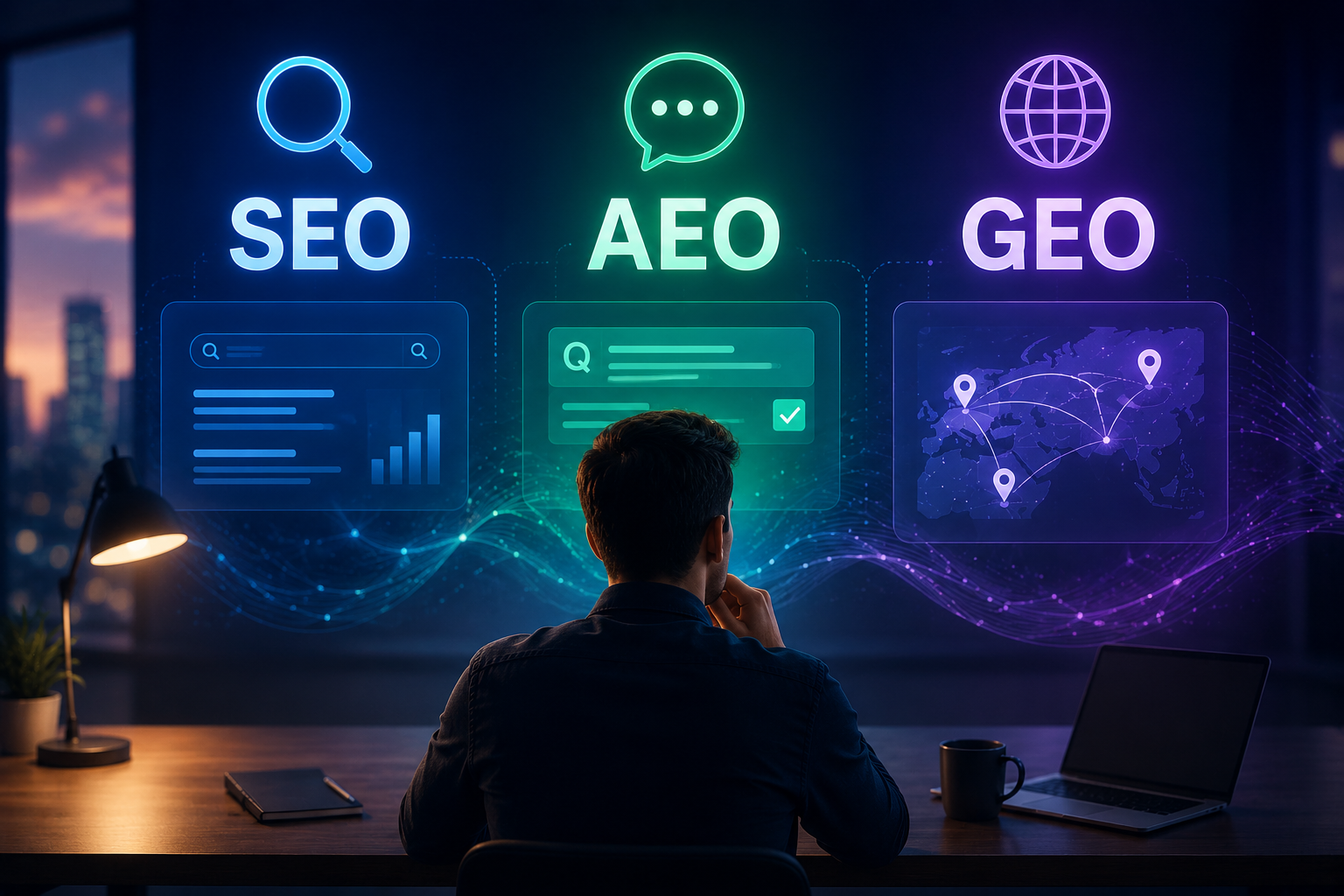
SEO vs AEO vs GEO is one of the clearest ways to understand how search is changing in 2026. Search didn’t just change. In practice, it split into three.
For twenty years, the deal was simple: rank on Google, get the click. However, that deal no longer holds. Today, a single question from a potential customer can be answered in three completely different places: a ranked search result, a direct answer box, or a sentence generated by ChatGPT that never sends them to your website at all.
In other words, SEO gets you ranked, AEO gets you the answer, and GEO gets you cited. None of the three replaces the others, and understanding exactly how they differ is the first step to showing up wherever your customers are actually looking.
SEO vs AEO vs GEO: Key Differences
| SEO | AEO | GEO | |
|---|---|---|---|
| Stands for | Search Engine Optimization | Answer Engine Optimization | Generative Engine Optimization |
| Optimizes for | Ranking position on Google, Bing | Featured snippets, voice answers, Google AI Overviews | Being cited by AI chatbots like ChatGPT, Perplexity, Claude |
| Win condition | Appear on page 1 | Become the direct answer | Become the source an AI trusts enough to reference |
| Core signals | Backlinks, technical health, keywords | Clear structure, direct answers, schema | Topical authority, entity clarity, third-party mentions |
| Best for | Transactional, high-click-intent queries | Quick factual questions | Research, comparison, and recommendation queries |
They’re not competing strategies. They’re layers. A page that ranks well through SEO has a far better chance of being pulled into a featured snippet through AEO, while a brand with strong topical authority is far more likely to get cited by an AI model through GEO.
What is SEO?
SEO is the discipline you already know: optimizing a website so search engines can crawl, index, and rank it for relevant queries. It’s built on three pillars: technical health (speed, crawlability, mobile usability), on-page relevance (content that matches search intent), and authority (backlinks and trust signals).
However, SEO still matters more than most “SEO is dead” headlines suggest. It remains the foundation everything else is built on: AEO depends on strong SEO fundamentals like crawlability and indexing, and a page that search engines can’t understand or trust won’t get surfaced by answer engines either.
What is AEO?
Answer Engine Optimization is the practice of structuring content so it can be pulled out and served as a direct answer, in a featured snippet, a voice search response, or a Google AI Overview. In other words, instead of optimizing purely for ranking position, AEO optimizes for being extractable: short, self-contained answers near the top of a page, clear question-based headers, and structured data that tells search engines exactly what your content answers.
Some frameworks treat AEO as the umbrella term for every system that returns an answer instead of a list of links: featured snippets, knowledge panels, voice results, and Google AI Overviews all fall under it, with GEO acting as the LLM-specific layer within that broader category.
What is GEO?
Generative Engine Optimization is the newest and least controllable of the three. Where AEO aims for a single snippet slot, GEO aims for something different: becoming one of the handful of sources an AI model chooses to reference while generating a conversational answer in tools like ChatGPT, Gemini, Claude, or Perplexity.
GEO leans on different signals than SEO or AEO: topical authority, consistent entity signals across the web, and third-party mentions on platforms the AI models trust. An analysis of AI platform citation patterns found that Google AI Overviews draw heavily on sources like Reddit, YouTube, Quora, and LinkedIn, which is a very different mix of trusted sources than a traditional Google ranking algorithm relies on.
Why this shift is happening now
This isn’t a theoretical debate. The numbers behind it are hard to ignore:
- ChatGPT had crossed roughly 900 million weekly active users by 2026, putting it among the most-used research tools in the world.
- Zero-click searches (where a user gets their answer without clicking through to any website) climbed from around 56% to 69% in a single year, according to Search Engine Land’s analysis of Seer Interactive data.
- Google AI Overviews reached an estimated 2 billion monthly users by mid-2025.
As a result, a growing share of your potential customers are getting their answer, and forming their opinion of who the trustworthy options are before they ever land on a website. If your brand isn’t part of that answer, it doesn’t matter how well you’d have converted them once they arrived.
What this looks like in practice
For example, abstract definitions are easy to nod along to and hard to actually picture. Here’s what the same buyer journey looks like as it moves through all three layers.
Imagine someone researching project management software for a 20-person marketing team.
Step 1: GEO. They open ChatGPT and ask, “What’s the best project management tool for a small marketing team?” ChatGPT doesn’t return a list of links. Instead, it names three or four tools directly, drawing on reviews, comparison articles, and community discussion it has learned to trust. If your brand isn’t part of that training and citation pattern, you’re not in the conversation at all, regardless of how well your website ranks.
Step 2: AEO. Intrigued by one of the names, they type “does [tool] integrate with Slack” into Google. Instead of a list of results, they see a Google AI Overview with a direct yes/no answer pulled from a specific page, usually from a well-structured integrations or FAQ page that answered the question in the first sentence, wrapped in clear headers and schema markup.
Step 3: SEO. Now seriously considering the tool, they search “[tool] pricing” directly. This time they want to compare, so they click through and land on a traditional search result, ranked because the page is fast, well-structured, and answers pricing questions in depth.
Three different intents, three different systems, three different optimization strategies, all inside a single afternoon of research by one buyer. Miss any one step, and you miss the buyer at that stage of their decision.
SEO vs AEO vs GEO: how they work together
The most common mistake is treating this as a choice. It isn’t. Each layer optimizes a different part of the buyer’s journey:
- SEO makes you discoverable when someone is ready to click and compare.
- AEO gets your answer in front of someone who wants a fast, direct response.
- GEO puts your brand into the shortlist an AI recommends when someone is still exploring options.
A buyer might encounter your brand through all three in a single research process by asking ChatGPT for recommendations (GEO), getting a quick answer to a follow-up question from a Google AI Overview (AEO), and finally clicking through to compare pricing pages on Google (SEO). Missing any one layer means missing part of that journey.
SEO vs AEO vs GEO by industry
How much weight each layer deserves also depends heavily on what you sell and how people buy it.
SaaS and B2B software
Buyers research heavily before ever talking to sales, often starting with a question to an AI assistant rather than a Google search. GEO deserves early, real investment here because being named in an AI-generated shortlist can matter more than a page-3 ranking bump. AEO matters too, for the dozens of specific feature and integration questions prospects ask along the way.
Ecommerce
Transactional intent still dominates. For example, someone searching “buy running shoes size 10” wants to click, compare, and purchase, not read a generated summary. SEO and traditional product-page optimization remain the priority, with AEO playing a supporting role for pre-purchase questions (“do these run small?”) that increasingly get answered directly in Google AI Overviews.
Professional services (agencies, consultants, law firms, clinics)
These are high-consideration, trust-driven purchases, and buyers frequently ask AI tools to recommend a provider before ever visiting a website. GEO and strong entity signals (consistent information across your site, Google Business Profile, and third-party mentions) often move the needle faster than traditional link-building alone.
Where Should You Start With SEO, AEO and GEO?
This is the question we hear most from founders and marketing leads trying to allocate a limited budget, and the honest answer depends on your starting point:
If your SEO foundations are weak (slow site, poor crawlability, thin content), start there. AEO and GEO both depend on search engines and AI systems being able to understand and trust your site in the first place. You can’t skip the foundation.
If your SEO is solid but you’re invisible in AI answers, prioritize AEO first: it’s faster to influence (structured data, FAQ formatting, and clearer content structure can show results in weeks) and it builds the extractable content GEO efforts can later point to.
If you’re in a competitive, high-consideration category (B2B software, professional services, anything people research before buying), GEO deserves real budget now, not later. It’s slower and harder to measure than AEO, but it builds the kind of durable citation presence competitors can’t copy by adding a bit of schema markup.
In practice, most businesses end up running a version of this sequence:
- Fix the SEO foundation: site speed, crawlability, mobile usability, and a clean sitemap. Nothing else works if search engines and AI crawlers can’t reliably access and understand your site.
- Restructure your highest-intent pages for AEO: rewrite key pages so the direct answer appears in the first two sentences, add FAQ sections in question-answer format, and implement schema markup (Organization, FAQPage, Article).
- Build the entity and authority signals GEO depends on: a consistent brand description across your website, About page, and third-party profiles; mentions and reviews on platforms AI models draw from; and content that demonstrates real expertise rather than surface-level keyword coverage.
- Track citations, not just rankings. Tools like Otterly, Profound, or Peec AI can show you when and how often your brand gets mentioned in AI-generated answers, giving you a second metric alongside traditional keyword rankings.
Frequently Asked Questions About SEO vs AEO vs GEO
What’s the simplest difference between SEO, AEO, and GEO?
SEO optimizes to rank as a result. AEO optimizes to be the answer. GEO optimizes to be the source an AI cites when generating that answer.
Does GEO replace SEO?
No. SEO remains the foundation of visibility in traditional search, and AEO depends on strong SEO fundamentals like crawlability and indexing to work at all.
How long does it take to see results from each?
AEO wins, like featured snippets, can appear within weeks. SEO and GEO authority typically build over several months and compound over time.
Can small businesses compete on AEO and GEO, or is this just for big brands?
Smaller brands with clear expertise and consistent messaging can often gain traction in AEO and GEO faster than in traditional SEO, where large, established competitors dominate the most competitive keywords.
Which platforms matter most for GEO?
ChatGPT, Google AI Overviews, Perplexity, and Claude are currently the platforms most businesses need to track, though which one matters most depends on where your specific audience already looks for recommendations.
See where your brand stands today
Reading about the difference is one thing. Knowing exactly where your brand appears, or doesn’t, across ChatGPT, Google AI, Perplexity, and traditional search is another.
Get your free AI Visibility Report →
Or explore how we build SEO, AEO, and GEO into one strategy: SEO for AI services →
Related posts
SEO vs AEO vs GEO: What’s the Difference in 2026?
SEO vs AEO vs GEO: What’s the Difference in 2026? SEO vs AEO vs GEO is one of the clearest ways

How to Rank in AI Search: Proven SEO, AEO & GEO Strategies for 2026
How to Rank in AI Search: Proven SEO, AEO & GEO Strategies for 2026 How to rank in AI search is

AI Search Optimization: The Complete Guide to Ranking in AI Search Engines
AI Search Optimization: the complete guide to AI ranking Search is undergoing one of the most significant transformations in its history.